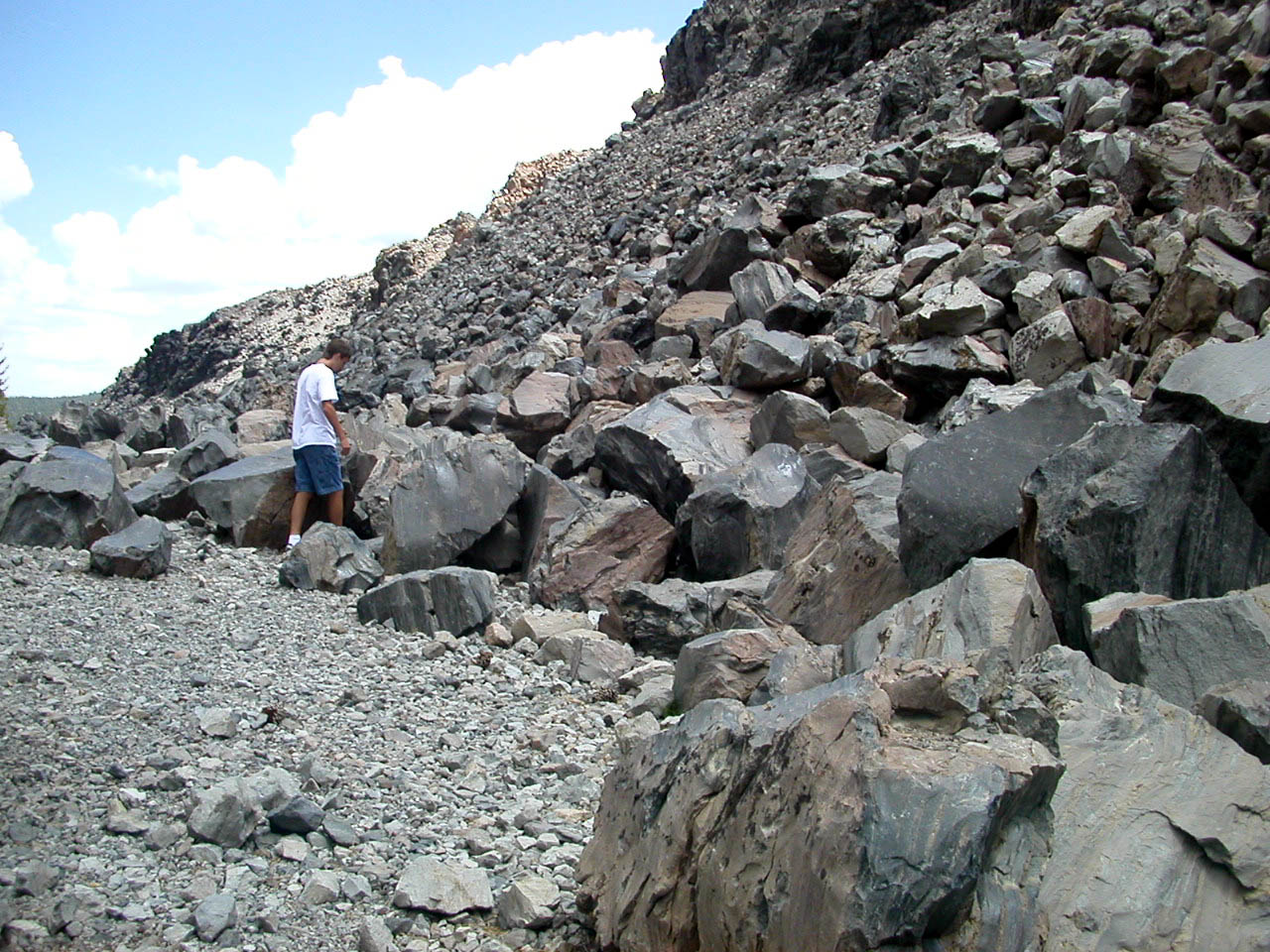
A polished palm-sized object can make obsidian seem like a material that arrives finished. The landscape is less orderly. At an obsidian dome or thick lava flow, glassy blocks may sit among pumice, crystalline rhyolite, ash, and angular talus. Surfaces weather, fracture, and become covered by lichen or dust.
Obsidian commonly forms from viscous, silica-rich lava whose movement is slow compared with fluid basalt. Rapid heat loss and high viscosity hinder crystal growth. Parts of one flow can cool into glass while other parts become pumice or crystalline rock, producing close associations that a display specimen does not show.
A fragment loses context
Once removed from its setting, a specimen no longer shows which layer or part of a flow it occupied. A label can preserve locality and collection history; without one, visual resemblance is not enough to restore that information. “Unrecorded locality” is more accurate than a confident guess.
Context matters even more for cultural material. Obsidian points and flakes can carry archaeological information that depends on their position and association. Collection from protected land may be prohibited, and moving an object can destroy knowledge even if the object itself is not damaged.
Read the landscape without removing it
Field observation can begin with photographs and notes: the relationship between dark glass and pale pumice, the size and angularity of blocks, flow banding, vegetation, slope, and weathered surfaces. Wide views record setting; close views record texture; a written note links them.
A specimen label is not an accessory. It is the remaining bridge between an object and a place.
The desk and the lava dome are two scales of the same story. The hand specimen makes fracture and luster easy to examine. The landscape restores volume, variability, and the fact that volcanic glass forms as one component of a larger eruptive system.