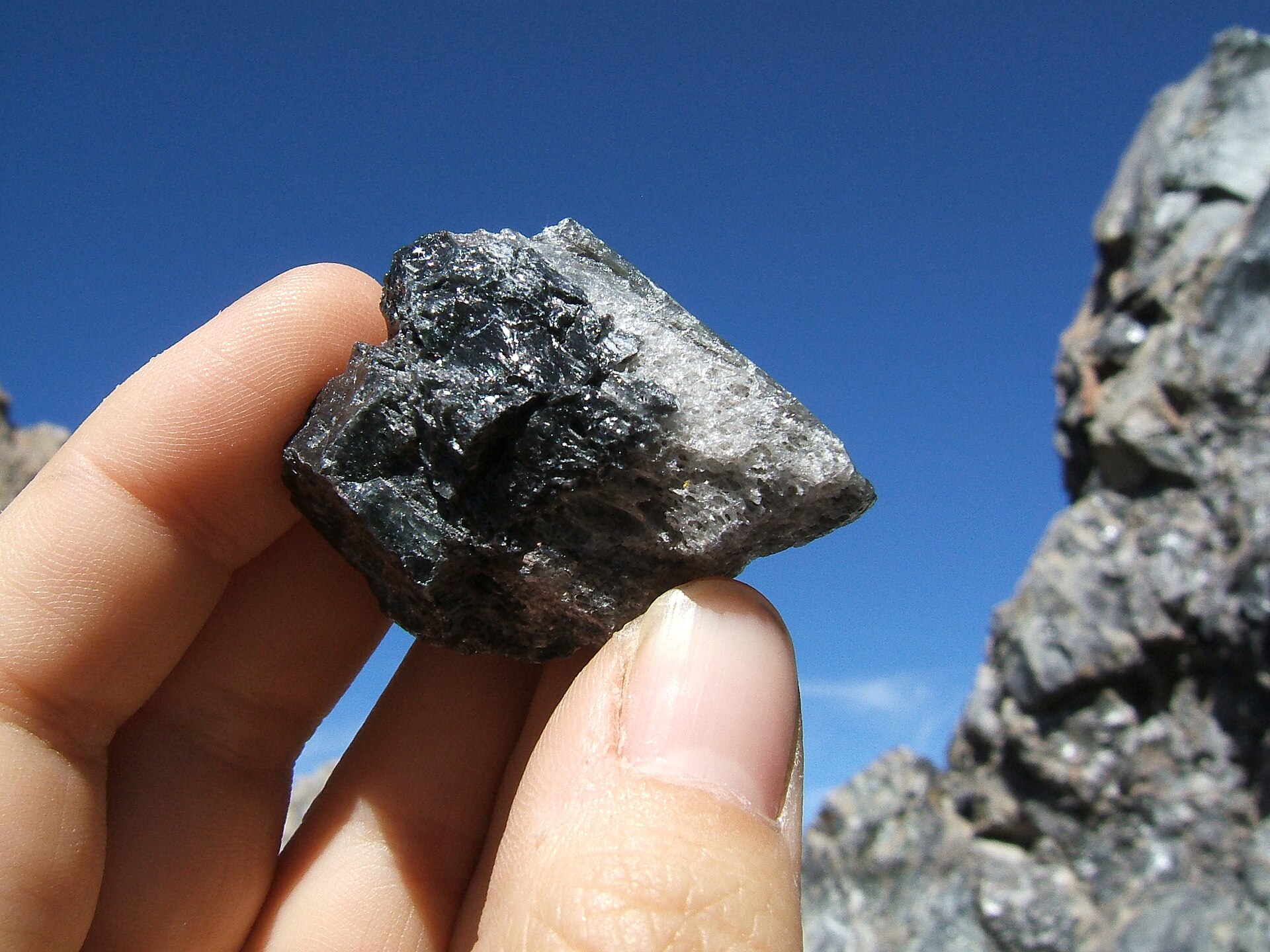
The first impression is simple: the specimen is black. That description lasts only until the light is moved. A narrow grey line appears along one edge, then widens into a curved patch before disappearing again. The body of the glass has not changed; the angle between surface, light, and observer has.
A dark glassy surface does not reveal its shape through color variation as readily as a pale, granular rock. Much of the form is carried by reflection. A broad, undisturbed surface can look almost empty, while a broken margin catches the light as a sequence of arcs and thin bands.
Follow the highlight
With one soft lamp, the useful movement is small. Rotate the specimen slowly rather than moving the lamp around the room. A highlight that travels smoothly belongs to a continuous curved surface. A highlight that breaks into short steps may be crossing several overlapping fracture scars.
The edge is easiest to read when it is allowed to remain black. The goal is not to brighten everything, but to place one controlled reflection.
The USGS describes obsidian as volcanic glass that commonly breaks in smoothly curved, conchoidal shapes. The visual evidence here is consistent with that description: there are no flat cleavage planes repeating in a crystalline direction. Instead, the broken edge forms nested curves.
What the photograph cannot establish
Reflection alone does not prove that an unknown black object is obsidian. Manufactured glass, furnace slag, and other materials can also be glassy and conchoidally fractured. Locality, context, inclusions, density, and—when appropriate—professional analysis matter. The photograph is best treated as a record of surface geometry, not a complete identification.
That limit is useful. It keeps the note close to what was actually seen: a black body, a thin moving reflection, several curved fracture lines, and one clean edge.