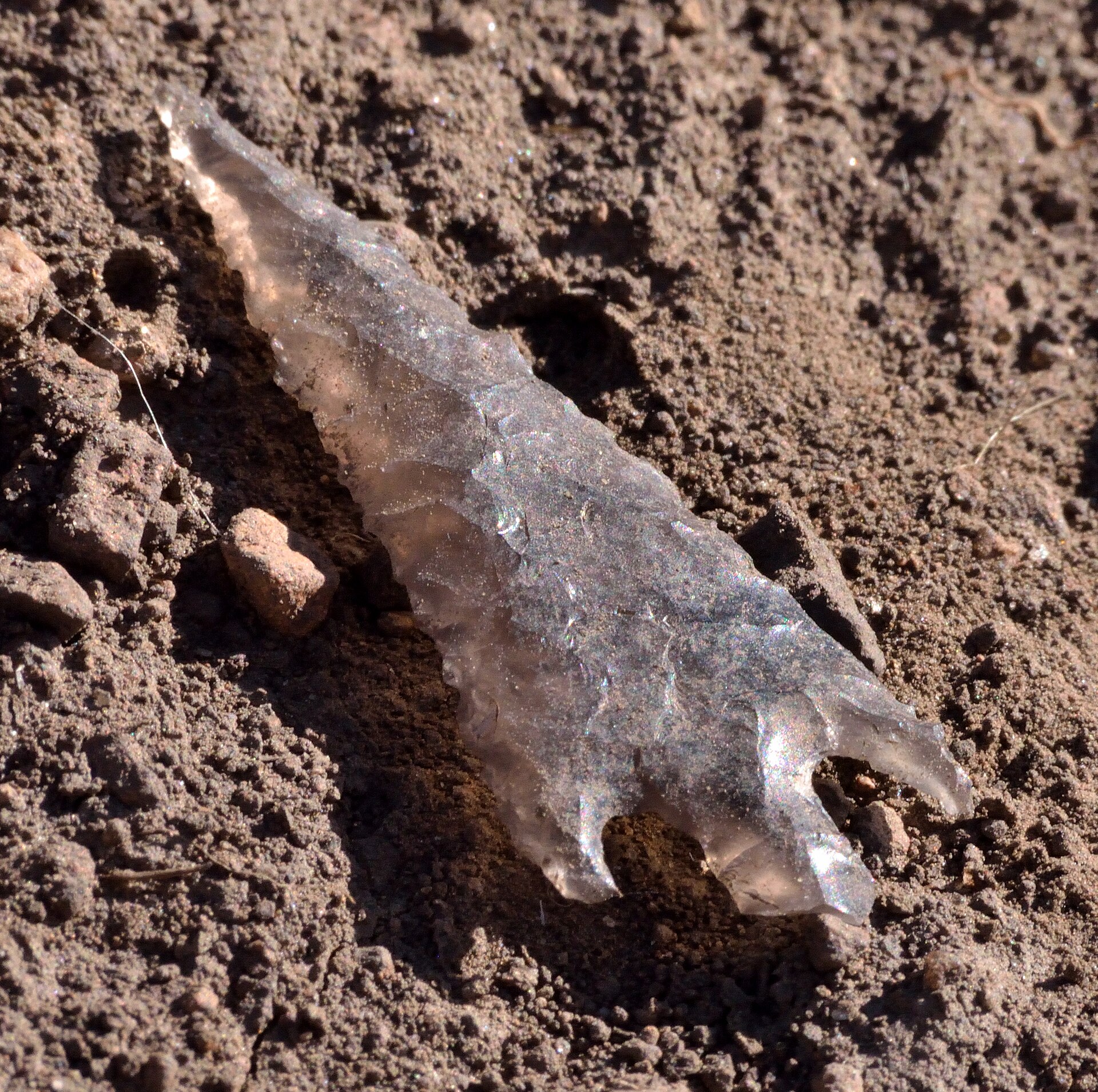
Crystalline minerals often split along planes related to their internal structure. Glass has no repeating crystal lattice to guide a crack in the same way. When stress moves through a uniform glassy material, the resulting surface commonly curves like the inside of a shell. This is conchoidal fracture.
On obsidian, the broad curve may carry smaller details. Ripple marks spread away from the point where force entered. A rounded swelling—the bulb of percussion—can form near that point. On a worked piece, later removals overlap earlier scars, creating a record of successive blows.
Geometry rather than decoration
The patterns are not bands of color laid down during cooling. They are surfaces created by breakage. Directional light makes this distinction easier: the marks change strongly as the specimen rotates because they are shallow three-dimensional features, not merely pigment.
USGS and National Park Service descriptions connect this predictable fracture with obsidian’s long use as toolstone. Controlled flaking can create extremely fine edges. That fact is also a safety warning. An unworked fragment can be sharp enough to cut skin even when the edge does not look dramatic.
A careful vocabulary
- Conchoidal surface: a smooth, broadly curved fracture resembling a shell.
- Ripple marks: smaller waves recording propagation of the fracture.
- Flake scar: the negative surface left when a flake is removed.
- Bulb of percussion: a rounded feature near the force entry point on a detached flake.
These terms describe visible structure; they do not authenticate an artifact or establish age. Archaeological objects require context, documentation, and professional assessment. For an ordinary hand sample, the same vocabulary is still valuable because it replaces “shiny black rock” with observations that can be checked.