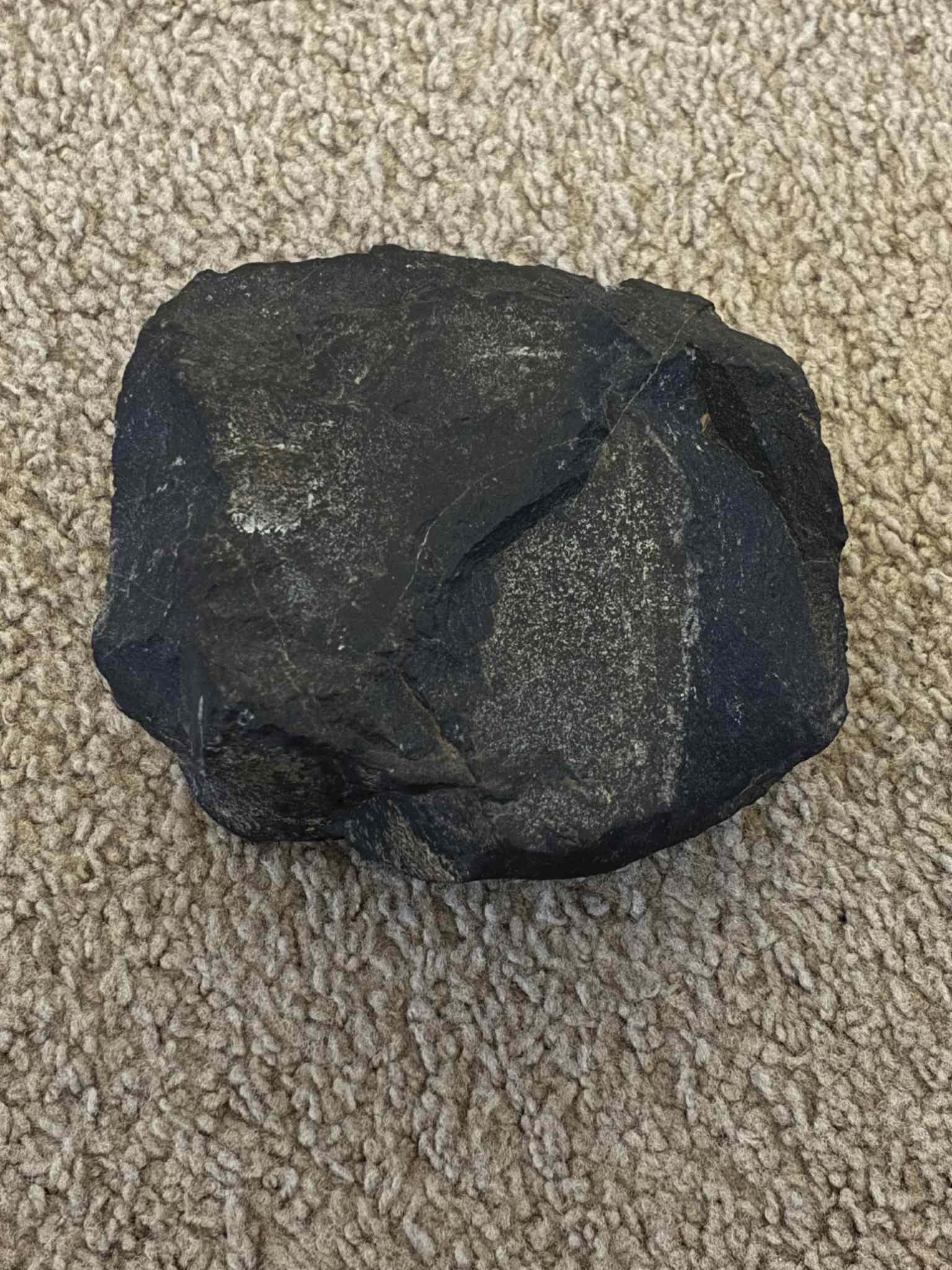
Color is an efficient first description and a poor final identification. Obsidian and basalt can both appear black or dark grey, especially in a small photograph. At hand-specimen scale, their surfaces usually tell very different stories.
Typical obsidian is volcanic glass, commonly associated with silica-rich rhyolitic magma. Typical basalt is a crystalline volcanic rock produced from more fluid, silica-poor magma. The distinction is not “black glass versus black stone” in every possible case, but that contrast is a useful place to begin.
Luster and grain
A fresh obsidian surface often carries a continuous glassy reflection. No individual grains need be visible because the material is glass. Basalt usually looks duller and fine-grained. Its crystals may be microscopic, but the surface often scatters light rather than returning one clean highlight.
Basalt can contain obvious larger crystals, vesicles left by gas bubbles, or weathered rusty surfaces. Obsidian can contain bubbles, crystals, flow bands, and devitrified patches. These exceptions are why several features should be considered together.
Fracture and eruption style
Obsidian commonly shows smooth conchoidal fracture. Massive basalt may also fracture in curved ways at a small scale, but it commonly breaks across a crystalline groundmass with a rougher appearance. At landscape scale, fluid basaltic lava can travel far and build broad flows, whereas viscous silica-rich lava tends to move slowly and form thick flows or domes.
“Dark” describes reflected light. “Glassy” and “fine-grained” begin to describe material and texture.
Without a known locality or analytical data, a visual comparison remains provisional. Still, replacing a one-word color match with luster, grain size, bubbles, fracture, and weathering produces a far more useful field description.