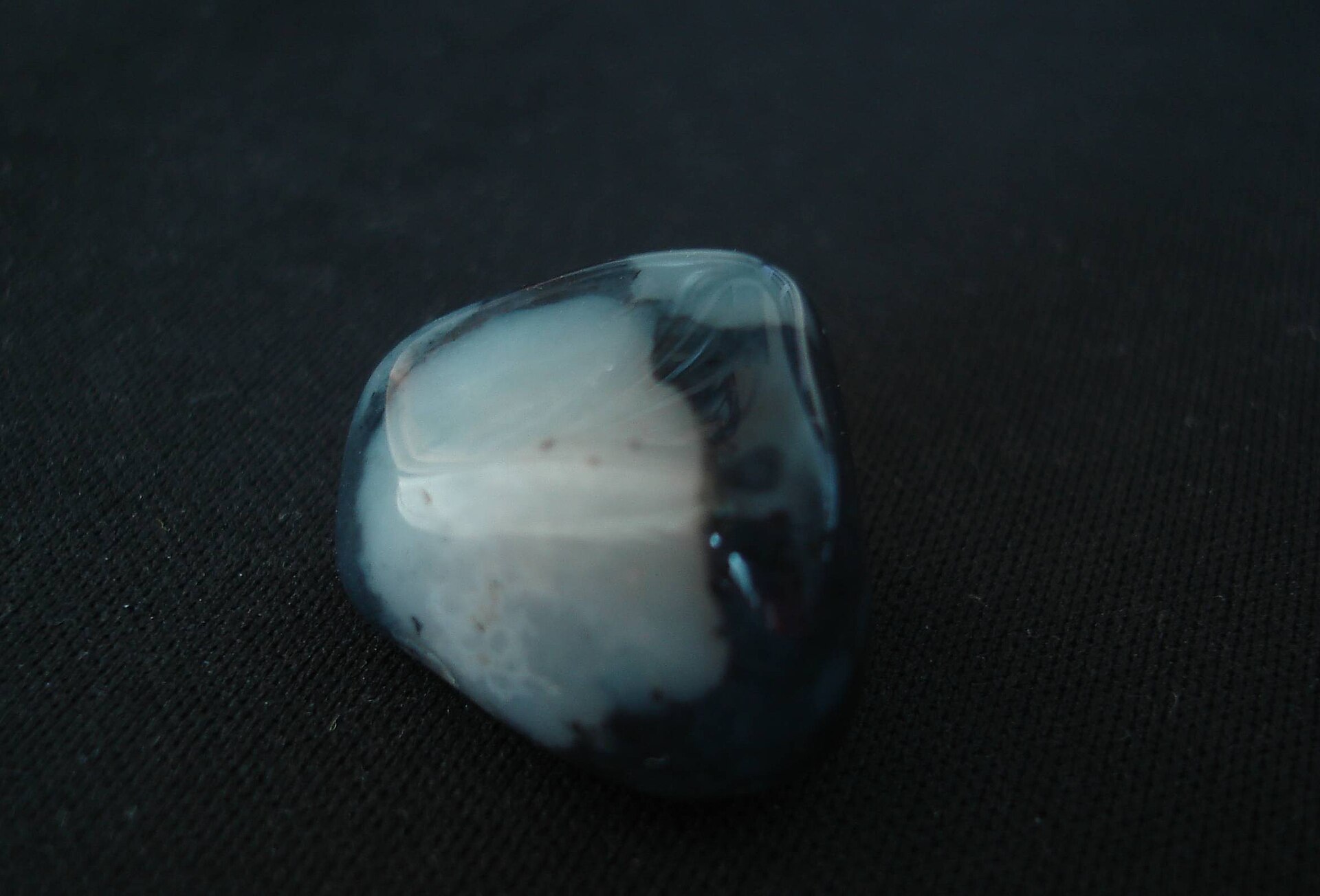
The pale forms in snowflake obsidian are often circular, radiating, or flower-like. Their soft edges look suspended in the black glass. They are not trapped snow, pigment, or fossils. They are places where the glass has begun to crystallize.
Fresh obsidian is glass because its atoms did not arrange into a regular crystalline structure while the lava cooled. Glass is not necessarily permanent on geological time scales. Given time and suitable conditions, parts of it can reorganize. This process is called devitrification.
Spherulites in the glass
In snowflake obsidian, radiating aggregates called spherulites grow within the darker glass. The pale material commonly includes cristobalite, a silica mineral. A cut and polished surface reveals these three-dimensional growths as spots and branching rosettes of different sizes.
The pattern can be attractive, but appearance alone does not tell a complete cooling history. Growth may vary across a flow, and later alteration can complicate the texture. The useful observation is modest: pale radiating patches interrupt a glassy black ground, indicating partial crystallization.
Polish changes the view
Commercial snowflake obsidian is frequently polished. Polish removes surface roughness and creates a continuous reflection, making the contrast between pale spherulites and dark glass easy to photograph. It also hides the natural weathered surface and may soften fracture features. A polished object and a fresh field fragment answer different questions.
The name “snowflake” is descriptive rather than mineralogical. The specimen remains a variety of obsidian, while the pale pattern records that the glass is no longer entirely glassy.