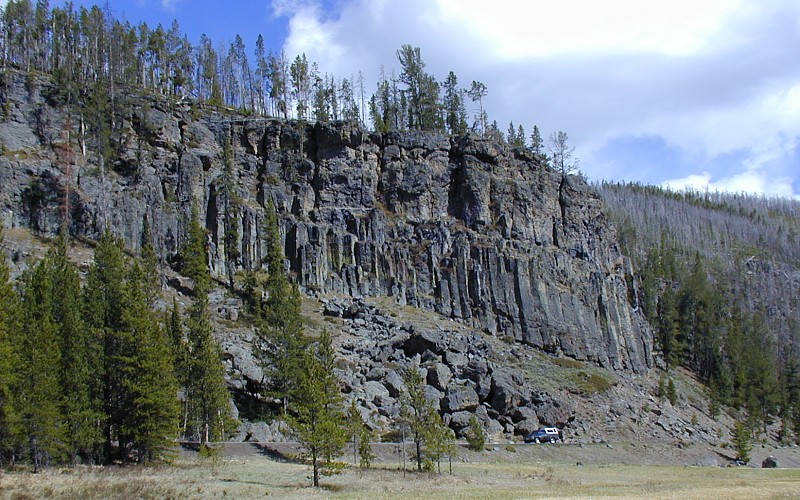
An exposed piece of obsidian rarely keeps the mirror-black finish of a fresh break. Dust settles into low spots. Thin mineral coatings add brown, grey, or pale patches. Edges lose their crispness, small pits interrupt reflections, and lichens may colonize a stable surface. These are useful observations—but none is a clock by itself.
The tempting shortcut is to call every dull surface a “hydration rind” and treat the dullest object as the oldest. That confuses two scales of evidence. Field weathering is a mixed record of abrasion, coatings, cracking, chemistry, burial, and exposure. Obsidian hydration is a specific interaction between water and volcanic glass, normally studied in a prepared section or with analytical instruments.
The layer is thinner than the story told about it
When a fresh glass surface is exposed, environmental water begins to enter the glass. Archaeological obsidian-hydration work measures the resulting microscopic band. The U.S. National Park Service describes the method as measuring the microscopic amount of water absorbed on freshly broken surfaces: longer exposure can produce a thicker band, but turning thickness into an age requires more than a ruler.
A well-known study from Obsidian Cliff measured hydration rinds in thin sections. Its groups averaged 16.3, 14.5, and 7.9 micrometres—dimensions far below unaided vision. Just as importantly, the thinner bands belonged to later cracks and surfaces. One hand specimen can therefore contain surfaces that began hydrating at different times.
Temperature and glass composition matter
Water does not move through every obsidian at one universal rate. Temperature strongly changes diffusion, while glass chemistry also matters. A surface warmed in a sunny, exposed setting has a different history from one in a cool cave or stable burial environment. Calibrated archaeological work must account for those conditions and for the composition of the source glass.
Hydration also occurs on more than one timescale. Research on Yellowstone perlite describes much thicker hydrated zones associated with water entering hot volcanic glass during post-eruptive cooling. Hydration-induced stress can produce nested, “onion-skin” fractures. That geological process should not be casually equated with the thin rind used to study the exposure history of an archaeological flake.
What a careful photograph can support
A field photograph can document gloss, roughness, pitting, coatings, cracks, lichen, and the relationship of a surface to soil or talus. Use raking light, include a scale, and photograph both the object and its setting. Describe what is visible before naming a process: “matte brown coating along one face” is stronger evidence than “ancient patina.”
Visible weathering is an observation. A hydration date is a calibrated measurement. The first cannot substitute for the second.
Even a microscopic band does not automatically date the whole object. It dates the start of exposure for the measured surface under a stated model. Sampling may also be destructive, and archaeological material should remain in context and be handled only by qualified researchers with the relevant permission.
Hydration is not devitrification
A final distinction helps prevent another common mix-up. Hydration involves water entering and altering glass near a surface. Devitrification is the reorganization of glass into crystalline material. The pale spherulites in “snowflake” obsidian are evidence of devitrification, not visible hydration spots. Both change volcanic glass, but they are different processes and answer different questions.
The honest conclusion at hand-specimen scale is often modest: this surface has changed, and the changes can be recorded. Determining how, when, and under what conditions requires context, microscopy, composition, and a suitable calibration—not a glance at how shiny the piece appears.